Midway-Clowns-Full-Disassembly-and-C-Port
Clowns — disassembly and C port
An AI-assisted disassembly of Clowns (Midway, 1978) and a complete, playable 1:1 C port of it — no emulation, no 8080 core at runtime; the original program itself, translated one routine at a time. The reverse engineering and the port were done together with an AI assistant (Anthropic’s Claude). Every table is read from the ROM image rather than retyped, and every behavioural question was settled by running the ROM, not by guessing: the port is compared with the real ROM, byte for byte, after every main-loop pass and every interrupt.
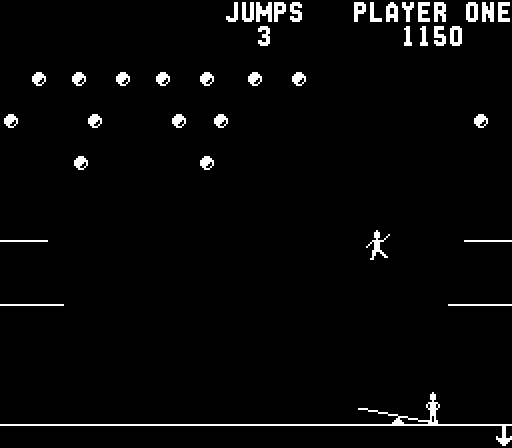
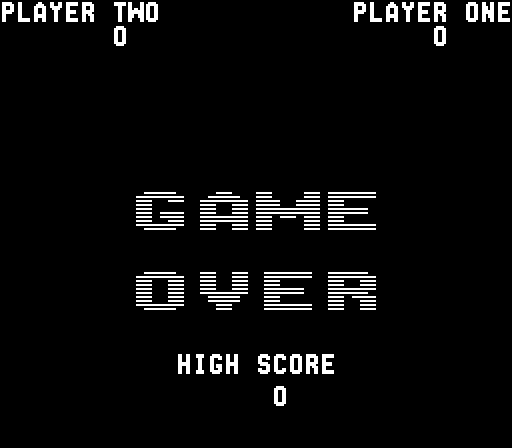
The C port, clowns_win.exe.
Every bitmap in the ROM
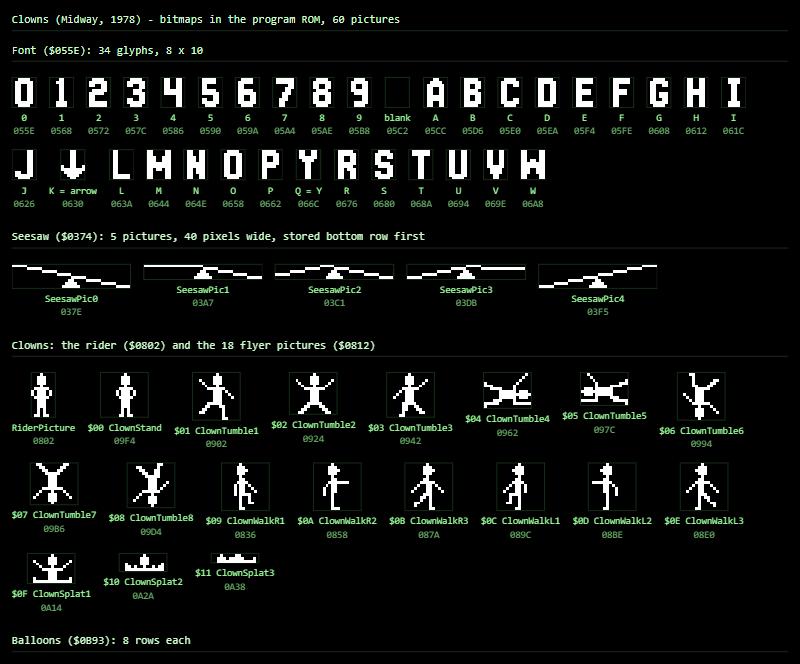
sprites_preview.html,
generated from the ROM by disasm/emit_sprites.py — click the picture for the live page.
Same layout as the Tempest and Space Duel projects.
What is here
disasm/ |
The annotated disassembly of the program ROM (MAME clowns, rev. 2, $0000-$17FF): clowns_program_rom.asm — every byte, 207 named labels, 137 routine headers — and clowns_defines.asm, with the generator that builds them from a ROM set and a verifier that re-encodes every line (6144 of 6144 bytes, 0 mismatches). sprites_preview.html draws every bitmap in the ROM. |
c_src/ |
The C port: one C function per routine of the listing, the machine’s RAM and video RAM as raw arrays, a Windows build that plays (clowns_win.exe), and tests\lockstep, which runs the real ROM on an 8080 core beside the port: 16 scenarios, about 1.2 million compared events, 96 % of the ROM’s instructions executed and verified. |
roms/ |
Not included. Put your own MAME clowns.zip here. |
Quick start
c_src\clowns_win.exe runs as it is. Keys: mouse or Left / Right for the seesaw,
5 coin, 1 / 2 start, F2 self-test switch, F3 reset, Esc quit.
After power-on the ROM shows GAME OVER for about 16 seconds before its demo starts
and it accepts a coin.
To rebuild everything from a ROM set (Python 3 and Visual Studio 2022):
cd disasm
python gen_from_roms.py

cd ..\c_src
python tools\gen_state.py
python tools\gen_roms.py
build_win.bat
To run the verification:
cd c_src
build_all.bat
run_tests.bat
The game, as the ROM plays it
Three rows of twelve balloons drift across the top (20, 50 and 100 points, bottom to top). A clown walks out on one of four ledges and jumps; the player moves the seesaw so that the clown lands on its raised end, which launches the clown standing on the other end — straight up from the middle of the landing zone, sideways from its edges, faster as the game goes on. A clown that hits the floor, or the wrong part of the seesaw, costs a jump. Clearing a row (or all three, by switch) pays a bonus and refills it; a switch-selected score gives an extra jump, another a bonus game.
Inside, the program is a small script interpreter in the foreground — attract mode,
coin handling and every jump are sequenced by 17 script commands — while two
interrupts per frame do all the drawing of the moving objects through the board’s
MB14241 shifter. disasm/README.md has the overview.
Limits
- The tone generator’s pitch is exact; the balloon pops, the springboard hit and the miss sound are approximations by ear, not models of the discrete circuits.
- The port takes interrupts between main-loop passes, never in the middle of one.
- Black and white, as the board; no colour overlay.
Details in c_src/README.md.
Credits
- Clowns: Midway Mfg. Co., 1978. No ROMs are distributed here.
- Hardware facts (memory map, ports, switches, interrupts, the MB14241 shifter, the
tone generator): the MAME driver
mw8080bw.cpp/mw8080bw_a.cpp. - The 8080 core used by the test oracle: Mike Chambers’ Intel 8080 emulator (public domain), as converted for the AAE emulator.
- Listing format and port structure: the Tempest and Space Duel projects.